
48h
Window in which HRV’s return to baseline tracks the restoration of processes disrupted by exertion.
8 hours of sleep. Still exhausted. Visualize the push and pull in your exertion and recovery cycle. Keep a close eye on your heart rate, sleep quality and volume, and determine which daily habits and stress factors are affecting your body's ability to repair.
“Heart rate variability is a measure of stress and recovery within the body, from a physiological standpoint.”
Vincent Luppino, PT, DPT · Hospital for Special Surgery
Heartbeats are inconsistent, and the small degrees of variability between each beat are completely normal. That variation is a non-invasive view into physiological recovery, stress, and overall health.
At rest, high HRV indicates a predominance of parasympathetic activity—a relaxed, recovered state. Low HRV reflects greater sympathetic activation, often associated with stress or fatigue.
Counter-intuitively, less variation is not better. We read it overnight, where the measurement isn’t coloured by the day’s activity.
Heart Rate Variability
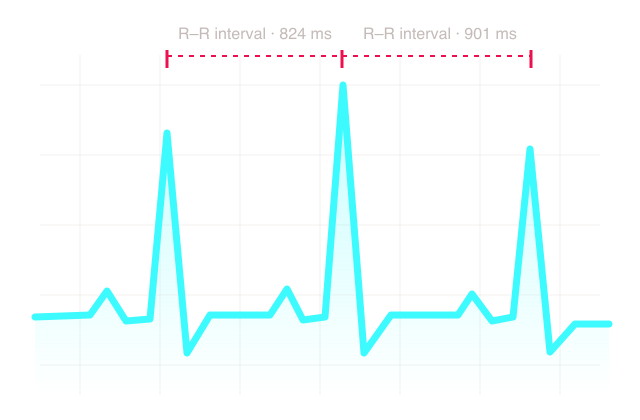
Most people train on a calendar. The calendar doesn’t know you slept badly, flew yesterday, or are fighting something off. Measured accurately, HRV can help tell whether your body is primed for a hard workout or needs lower intensity—or rest.
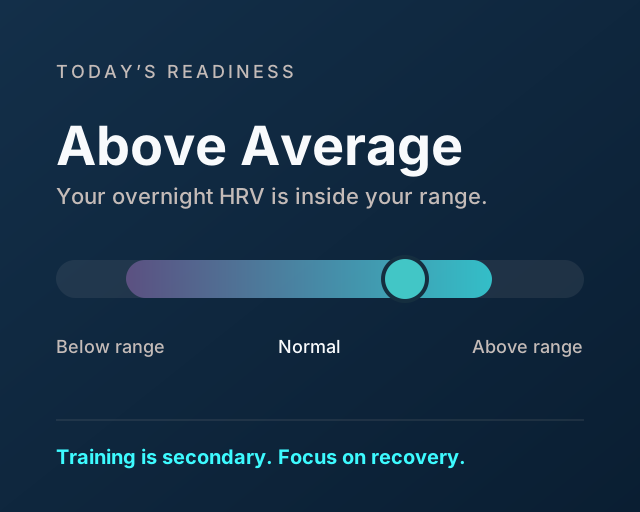
When your score sits within or above your normal range, moderate-to-high intensity is on the table. Guided this way, training can respond to you instead of forcing you to respond to a plan.
Treat it as a tie-breaker, not a verdict. When the number and your body disagree, trust your body—HRV informs the decision, it doesn’t make it.
48h
Window in which HRV’s return to baseline tracks the restoration of processes disrupted by exertion.
-15.6%
Typical HRV Drop on nights that involve alcohol consumption; along with a 35 minute drop in total sleep volume, and a 7% drop in sleep quality.
1 - 2 days
Wearable heart rate monitor users often report a sharp HRV drop a day or two before illness symptoms.
Fatigue announces itself late. Physiology announces it early.
Why a declining trend matters more than a bad night
A consistently declining HRV is one of the earliest signs you’re pushing too hard without enough rest—a signal to ease up before digging a recovery hole that’s hard to climb out of.
Gradual increases in average HRV, meanwhile, correspond with improved aerobic fitness, readiness to train, and recovery ability.
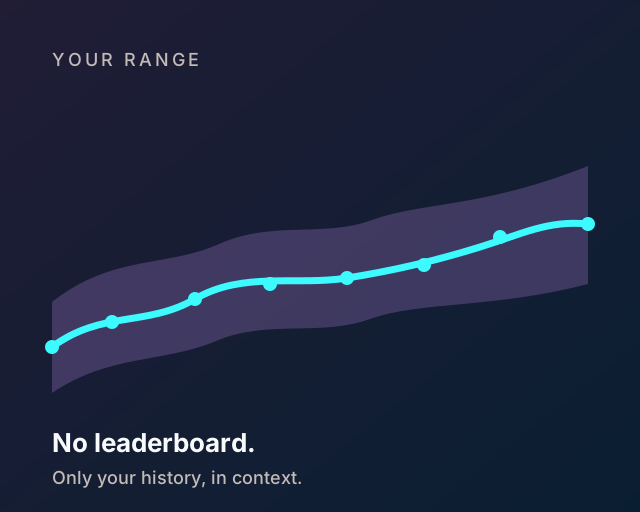
There’s no leaderboard here. An average daily HRV of 30 ms can be completely normal for one person while 90 ms is normal for someone else. Age, fitness, genetics, medication, stress, illness, sleep, and measurement method all move the number.
We never show you a score against a population. We show you a range built from your own months of data, and where this morning falls inside it.
And we don’t let one number ruin your morning. A drift that stays down for days, while training and life stress pile up, is the signal worth acting on.
“Outside of appropriate programming, our best recovery tool is adequate sleep.”
Sapphire Physical Therapy
Work stress, poor sleep, dehydration, illness, a hard conversation—stress is stress, and your nervous system answers all of it. Think of HRV as a stress barometer for your whole being, not just your legs.
That’s why it doesn’t only tell you when to rest your muscles. It can tell you when your mind needs space to reset—and it moves in response to how you breathe, move, rest, and regulate yourself.
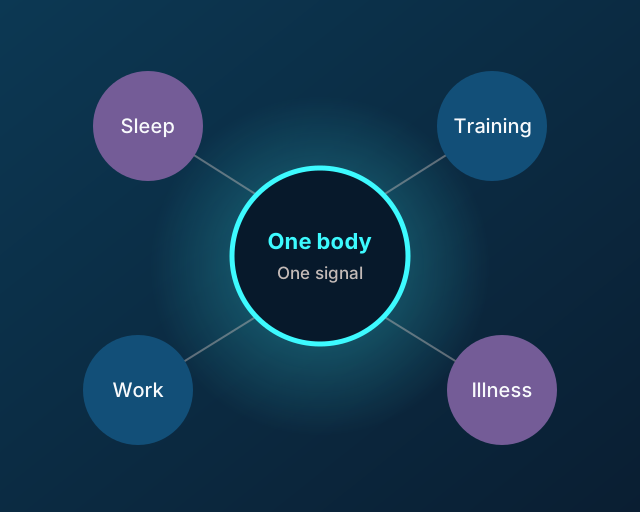
Physiological recovery is how the body unwinds from daily strain. The body adapts and improves during recovery, not during the stress itself. HRV Link reads your history and hands you useful context each morning.
Not a diagnostic device. Resting HRV does not reliably reflect overreaching, and its link to injury risk is not yet validated in humans—we’ll always say so.